

The lesson guides students from recognising gender inequality, through research and perspective-taking, to structured argumentation and reflection, using real-world examples and interactive discussion formats. The focus is on understanding inequality in the workplace and critically analysing the concept of a women’s quota.
Subject-specific objectives
By the end of the lesson, students will be able to:
Focus: Awareness of inequality and identification of key issues
Focus: Building knowledge and analysing real-world examples
Focus: Evaluating solutions and understanding multiple perspectives
Focus: Connecting general inequality to a concrete policy debate
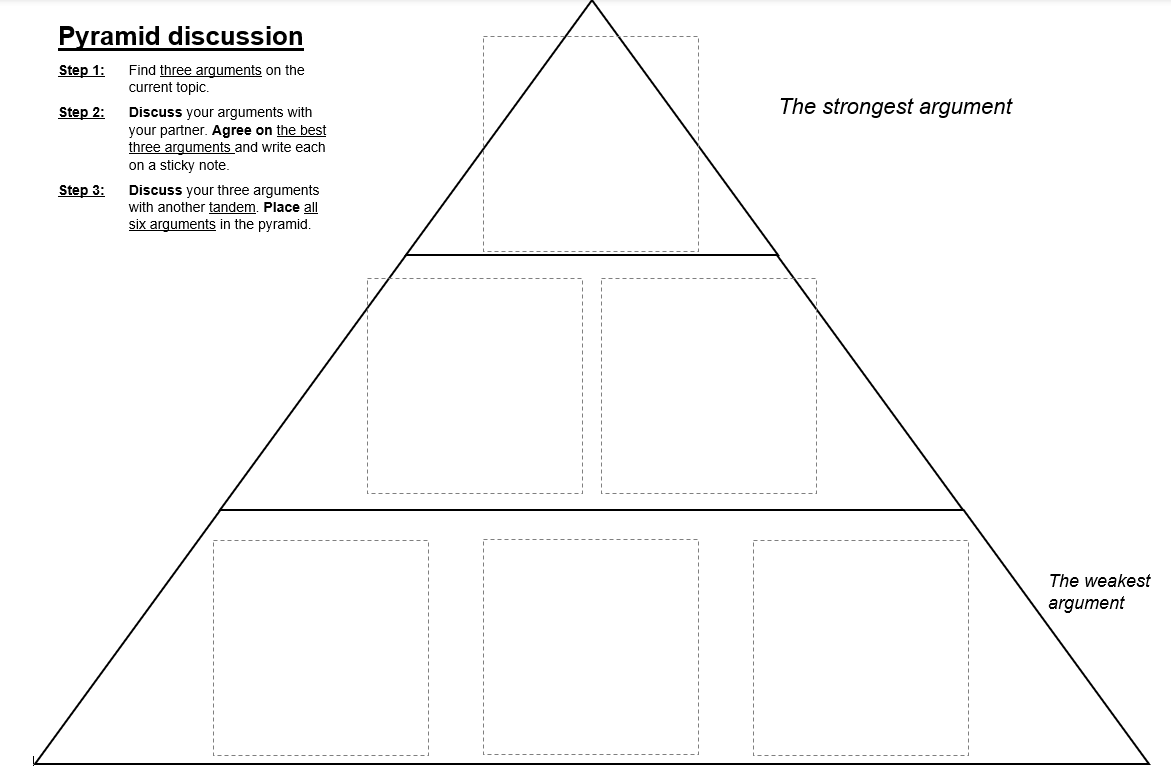
Students work for or against the motion using a structured pyramid method.
Step 1 – Individual work:
Step 2 – Pair work:
Step 3 – Group work:
Focus: Structuring arguments and anticipating counterarguments
Focus: Spoken interaction, argumentation, and feedback skills
Focus: Personal responsibility and reflection
Formative Assessment
Rubrics focus on creativity, critical thinking, depth of research, presentation quality, and reflection.
The lesson follows a problem-oriented and discovery-based approach. Students first become aware of gender inequality through real-life scenarios, then build knowledge through research and discussion. Structured argumentation methods and role-based discussions help students analyse complex issues from multiple perspectives. The final reflection phase encourages students to transfer their learning to their own lives and future professional contexts.
Source: eurostat, March 7, 2022, https://ec.europa.eu/eurostat/de/web/products-eurostat-news/-/edn-20220307-2
Source: Bec Eaton, August 19, 2024, https://vervoe.com/gender-discrimination-in-hiring-practices/
Source: Kim Parker, October 1, 2015, https://www.pewresearch.org/short-reads/2015/10/01/women-more-than-men-adjust-their-careers-for-family-life/
Source: UK Time Use Survey, 2014-2015, https://www.researchgate.net/figure/The-gender-gap-in-time-use-among-parents-Unit-Daily-minutes_fig1_341851838
Basic Law for the Federal Republic of Germany
Article 3
(1) All persons are equal before the law.
(2) Men and women shall have equal rights. The state shall promote the actual implementation of equal rights for women and men and take steps to eliminate existing disadvantages.
(3) No person shall be favored or disfavored because of sex, parentage, race, language, homeland and origin, faith, or religious or political opinions.
ROLE CARDS – EXAMPLES
Role Card 1: Female Perspective
Name: Sarah Miller
Age: 32
Job Title: Senior Analyst at a Tech Company
Background: Sarah has been working in the tech industry for 7 years and has experienced the challenges of the gender pay gap firsthand. She is passionate about advocating for equal pay and believes that systemic changes are essential to address this issue.
Position on Gender Pay Gap: Sarah believes that the gender pay gap is a significant issue that requires immediate action. She views it as a result of both overt discrimination and unconscious biases that affect hiring and promotion practices.
Out of Sara’s perspective: evaluate and comment on the presented solutions to reduce gender pay gap.
Role Card 2: Male Perspective
Name: David Thompson
Age: 40
Job Title: Human Resources Director at a Financial Firm
Background: David has over 15 years of experience in human resources and has been involved in implementing compensation policies within his organization. He is aware of the gender pay gap issue but believes that the reasons behind it are complex and multifaceted.
Position on Gender Pay Gap: David acknowledges that the gender pay gap exists but believes it is primarily influenced by factors such as career choices, negotiation practices, and work-life balance. He is open to discussing solutions but is cautious about measures that may unintentionally create division among employees.
Out of David’s perspective: evaluate and comment on the presented solutions to reduce gender pay gap.
Current case: Womens Quota
A government introduces a rule: big companies must have at least 40% women on their boards by a deadline. Some companies support it because it forces fairer selection. Others oppose it because they say it is “not merit-based.”
Motion: “The women’s quota reduces inequality between men and women.”
3 affirmative arguments
3 negation arguments
1 quick question to start discussion: If the goal is equality, is a quota a fair tool or the wrong tool?
Class Discussion Feedback Sheet – Example
Date: ___________________
Topic: ___________________
Participants: ________________________________________________________
Please provide your feedback on the following aspects of the discussion:
Arguments
Were the arguments presented in a clear and logical manner?
Were the arguments sufficiently developed and supported with evidence?
Did participants use a consistent structure for their arguments (e.g., claim, evidence, reasoning)?
Flow of Discussion
Did the discussion progress smoothly from one point to another?
Were participants able to build on each other's ideas effectively?
Language
Did participants use appropriate language and terminology for the discussion?
Were phrases for debate and discussion effectively utilized?
Any additional comments or suggestions for improvement?


.svg)
.svg)
.svg)

.svg)


.svg)
.svg)
.svg)
.svg)
.svg)